

In this guide, you’ll learn 50 common French words for beginners with pronunciation and examples.
Here’s a secret that experienced language teachers know: you don’t need to memorize thousands of words to start speaking French. Research shows that just 100–200 common words cover around 50% of everyday conversation. That means learning a handful of the right words gets you speaking much faster than you think.
This post gives you 50 of the most useful French words for beginners with pronunciation, meaning, and a short example sentence for each one. Bookmark it, print it, screenshot it. Let’s go!
1. Greetings. The Words You’ll Use Every Single Day
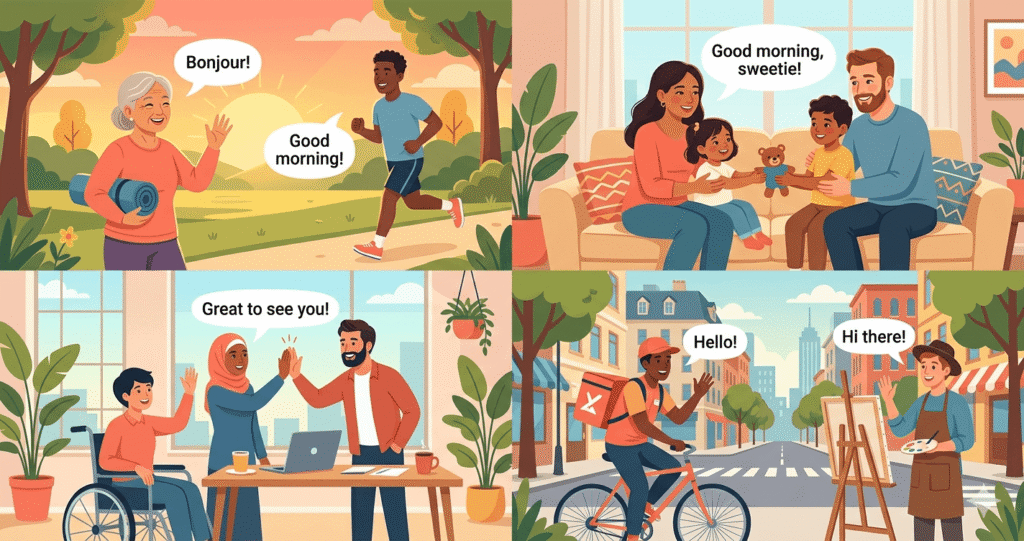
French people love a good greeting. Walk into any shop, café, or office, and the first thing you do is say “Bonjour.” Skipping the greeting is considered rude, so these words matter!
- Bonjour: Hello / Good morning (bohn-ZHOOR) Bonjour! Comment ça va? → Hello! How are you?
- Bonsoir: Good evening (bohn-SWAHR) Bonsoir, madame. → Good evening, ma’am.
- Salut: Hi (informal) (sah-LOO) Salut ! Tu vas bien ? → Hi! Are you doing well?
- Au revoir: Goodbye (oh ruh-VWAHR). Au revoir et bonne journée ! → Goodbye and have a great day!
- À bientôt: See you soon (ah byahn-TOH) À bientôt, mon ami! → See you soon, my friend!
- Bonne nuit: Good night (bon NWEE). Bonne nuit, dors bien. → Good night, sleep well.
- Enchanté(e): Nice to meet you (ahn-shahn-TAY). Je m’appelle Sophie. Enchanté ! → My name is Sophie. Nice to meet you!
2. Polite Words. Be Kind, Sound Fluent
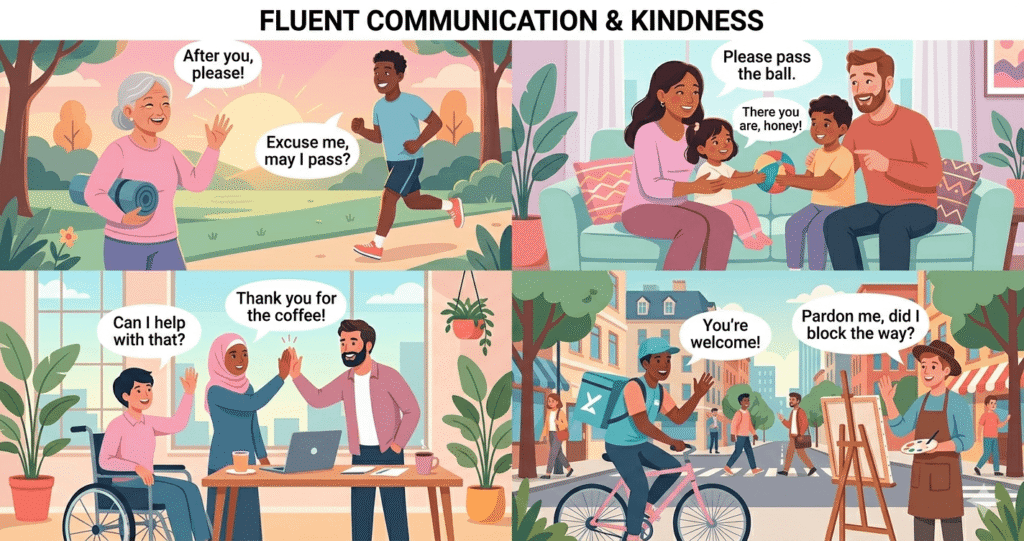
Politeness in French goes a long way. These small words will make you sound respectful and confident, even as a complete beginner.
- Merci : Thank you (mehr-SEE) Merci beaucoup! → Thank you very much!
- S’il vous plaît : please (formal) (seel voo PLEH) un café, s’il vous plaît. → A coffee, please.
- De rien : you’re welcome (duh RYAHN). Merci ! De rien. → — Thank you ! — You’re welcome.
- Excusez-moi : Excuse me (ex-koo-ZAY mwah). Excusez-moi, où est la gare ? → Excuse me, where is the train station ?
- Pardon : sorry / pardon (par-DOHN). Pardon, je ne comprends pas. → Sorry, I don’t understand.
- S’il te plaît: Please (informal) (seel tuh PLEH). Passe-moi le sel, s’il te plaît. → Pass me the salt, please.
- Oui / Non: Yes / No (wee / nohn) Oui, je parle français ! → Yes, I speak French!
3. Common Verbs — The Engine of Every Sentence

Verbs are the backbone of any language. Learn these ten and you can already build dozens of real sentences.
- Être : to be (EH-truh) Je suis étudiant. → I am a student.
- Avoir : to have (ah-VWAHR) J’ai faim. → I am hungry. (literally: I have hunger)
- Aller : to go (ah-LAY) Je vais à Paris. → I’m going to Paris.
- Vouloir : to want (vwoo-LWAHR) Je veux du café. → I want some coffee.
- Pouvoir : to be able to/can (poo-VWAHR) Pouvez-vous m’aider ? → Can you help me ?
- Faire : to do / to make (FAIR) Qu’est-ce que tu fais ? → What are you doing?
- Parler : to speak (par-LAY) Je parle un peu français. → I speak a little French.
- Manger : to eat (mahn-ZHAY) On mange à quelle heure ? → What time do we eat?
- Comprendre : to understand (com-PRAHN-druh) Je ne comprends pas. → I don’t understand.
- Aimer : to like / to love (eh-MAY) J’aime le chocolat. → I love chocolate.
Everyday Nouns, The Things Around You

These are the words for things you see, use, or talk about every day. Learn these and conversations become much easier.
- La maison : The house (la meh-ZOHN)
- La voiture : The car (la vwa-TOOR)
- Le travail : Work (luh trah-VY)
- L’eau : Water (loh)
- Le pain : bread (luh paN)
- L’ami / L’amie : Friend (lah-MEE)
- La famille : Family (la fah-MEEY)
- Le temps : Time / Weather (luh tahn)
- L’argent : (lar-ZHAHN)
- Le livre : Book (luh LEE-vruh)
- Le téléphone : Phone (luh tay-lay-FOHN)
- La rue — Street (la roo)
- Le restaurant — Restaurant (luh res-toh-RAHN)
- La ville : City / Town (la veel)
- Le jour : Day (luh zhoor)
- La nuit : Night (la nwee)
- L’heure : hour / time (lur)
- La question : Question (la kes-TYOHN)
- Le problème : problem (luh pro-BLEM)
- La réponse : Answer (la ray-POHNS)
Useful Expressions. Sound Natural Immediately

These little phrases are what make you sound like a real French speaker — not just someone reading from a textbook.
- C’est bon. : It’s good / That’s fine. (say bohn)
- Je ne sais pas. : I don’t know. (zhuh nuh say pah)
- Bien sûr ! : Of course! (byaN soor)
- Peut-être. : Maybe. (puh-TET-ruh)
- C’est combien ? : How much is it? (say com-BYAHN)
- Je m’appelle… : My name is… (zhuh mah-PEL)
- Où est… ? : Where is… ? (oo eh)
- Je voudrais… : I would like… (zhuh voo-DREH)
- Ça va ? : How’s it going? (sah vah)
- Ça va ! : I’m fine! / It’s going well! (sah vah)
Pro Tips: How to Memorize French Words Faster
Learning words is one thing; keeping them in your brain is another. Here’s what actually works:
Use the word the same day you learn it. Don’t just read it, say it out loud, write it in a sentence, or use it while cooking dinner. “Je veux du pain” while making toast is more effective than drilling flashcards for an hour.
Stick labels around your house. Put a sticky note on your door (la porte), your fridge (le réfrigérateur), and your mirror (le miroir). You’ll absorb them without even trying.
Learn words in pairs. Learn “oui” and “non” together. Learn “bonjour” and “au revoir” together. Your brain loves patterns and contrast.
Listen, even if you don’t understand yet. French music, podcasts, or TV shows in the background train your ear to the rhythm of the language. It works, even passively.
Review little and often. Ten minutes every day beats two hours once a week. Consistency is everything in language learning.
You’re Already on Your Way

You’ve just learned 50 French words. That’s not nothing; that’s the foundation of real conversation. Every fluent French speaker started exactly where you are right now: curious, a little nervous, and taking that first step.
The key is simple: keep going. Show up tomorrow. Review five words. Say one sentence. That’s it.
French will open doors for you to travel, to culture, to people, and to places you haven’t even imagined yet. And it starts right here, with Bonjour.
Bonne chance! Good luck! You’ve totally got this.